





To mark Earth Day 2023, we’ve offset our total carbon footprint for 2022 and are proud to be a signatory on the UN Climate Neutral Now Initiative, for the fourth consecutive year.
If you’ve been Team Moneybox for a while, you’ll know that every year we work closely with UN Climate Change verified Alectro, to conduct an in-depth analysis of our carbon footprint. This year, we’re thrilled that we’ve been able to maintain a carbon footprint of 0.72 tCO2e/employee which is well below the UK domestic target goal of 2.0 tCO2e/employee .
At a glance
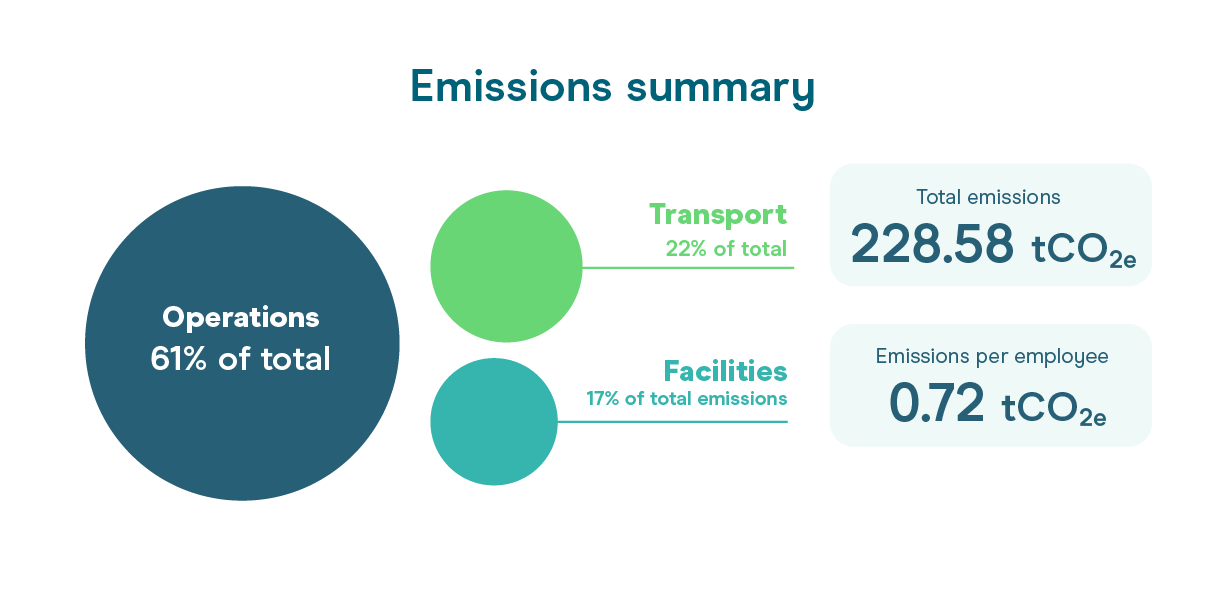
Following two very out-of-the-ordinary years from 2020-2021, last year was the first business-as-usual state since the pandemic. We were pleased to find that our total emissions for 2022 were 228.58tCO2e which, based on an average of 317 full-time employees, equates to 0.72 tCO2e per employee. Compared to the base reporting year of 2019, this figure is continuing on a downward trend on a per-person basis – despite the business tripling in size since then.
This is really promising and shows that our new ways of working not only offer better flexibility and balance for everyone here at Moneybox, but they’re helping to reduce our impact on the planet too.
Let’s take an in-depth look at our 2022 carbon emissions…
2022 carbon emissions deep dive
How we analysed our carbon footprint
We worked with third party Alectro to analyse all of Moneybox’s operational activity.* That includes company events, office facilities, work-from-home setups, employees and suppliers – this enabled us to map our carbon footprint and help us achieve carbon neutral status to the accredited standards. We ensured every offset met the toughest criteria** to have the largest impact possible.
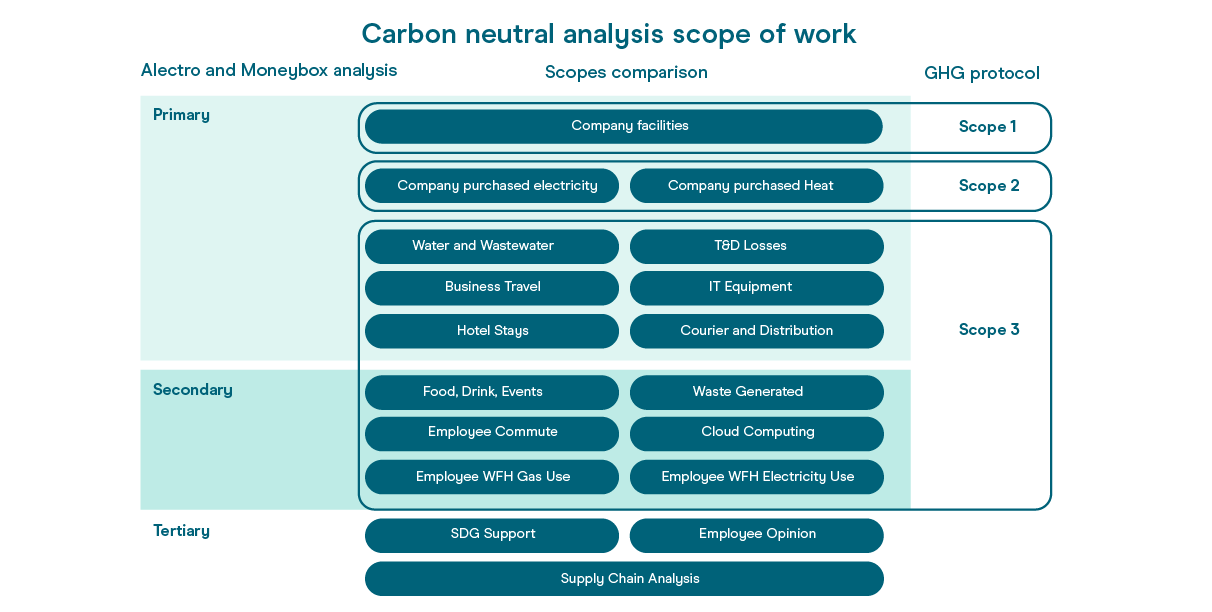
All our emissions can be broken down into three categories: operations, transport, and facilities.
Operations overview
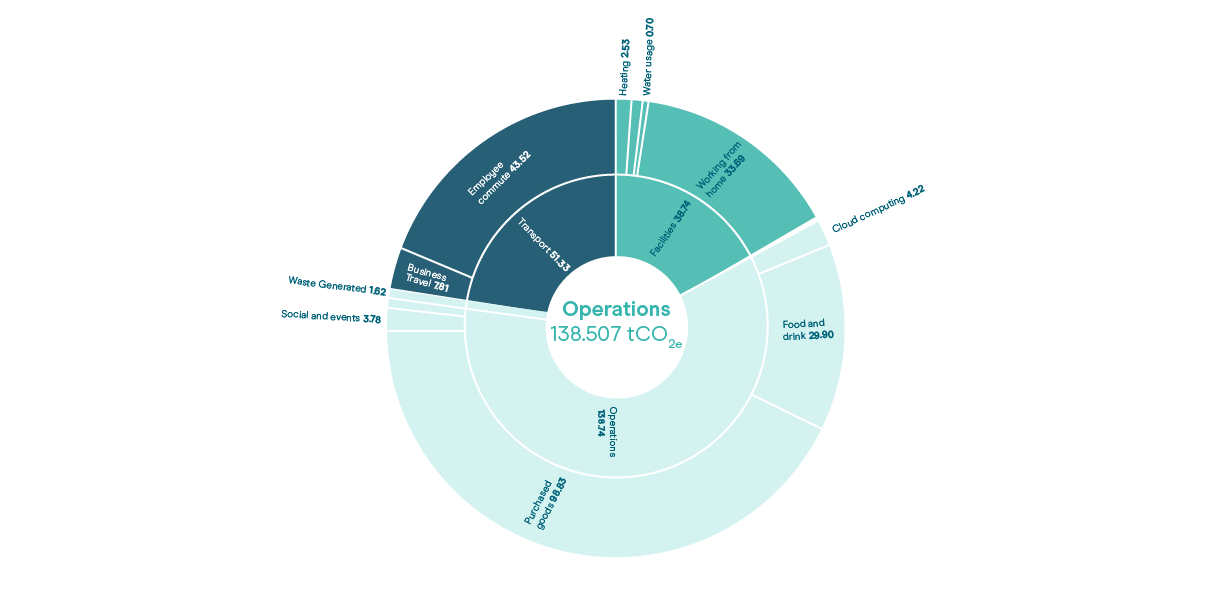
The operations category makes up the largest part of our carbon footprint. This category is dominated by Purchased Goods, which mainly refers to electronic equipment, while other purchased items, including gifts and home office setups, also contribute to the impact.
At Moneybox, we employ an Environmentally Preferred Purchasing policy, which essentially means that we purchase goods or services or work with suppliers that have a less negative effect on people or the environment.
- The total emissions from operations was 138.5 tCO2e
- In relation to the total emissions, operations accounted for 61%
Transport overview
While 2022 was back to business as usual, the Moneybox team spent a minimum of two days working from the office instead of all five – meaning commute emissions were cut for many. And when we did travel into the office, the vast majority of commutes were by low-carbon methods including walking, bus, tube, train, and cycling.
- As a whole, our total emissions from travel for 2022 came in at 51.3 tCO2e
- Transport made up 22% of our total emissions
- 97.04% of the total kilometres travelled in commuting were low carbon
- A small number of flights were recorded during the year, which made up for 0.88% of the total emissions
Facilities overview
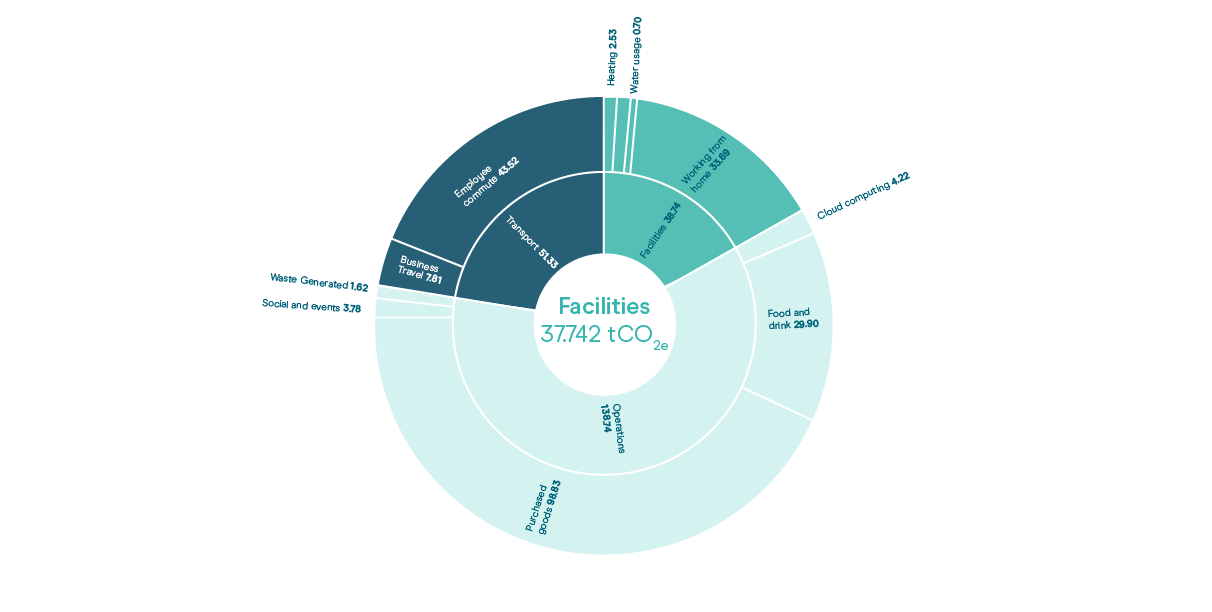
Moneybox’s office space benefits from electricity from a low-carbon provider, annual data reporting by the Facilities Management team, efficient gas consumption, and diligent monitoring and maintenance of refrigerants – all of which maintain a low carbon footprint.
- In total, our facilities emissions were 38.7 tCO2e
- Our carbon output from facilities made up 17% of the total
Emissions per employee
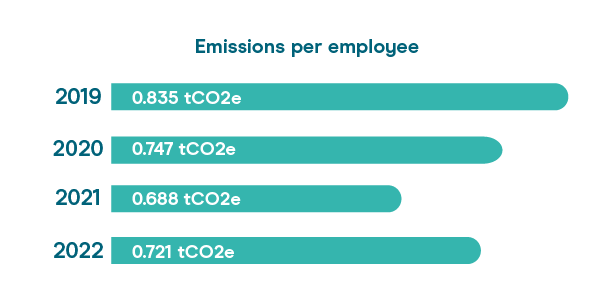
The pandemic has changed the landscape of working life for lots of people. Like so many businesses, we recognised the benefits of a hybrid approach to work and, for the year of 2022, trialled a minimum of two days in the office and three days working remotely. So far, this has proven to be a good balance for the Moneybox team and we’re delighted to see that it has also helped us lower our carbon footprint to a point below our last business-as-usual year.
How we offset our carbon footprint
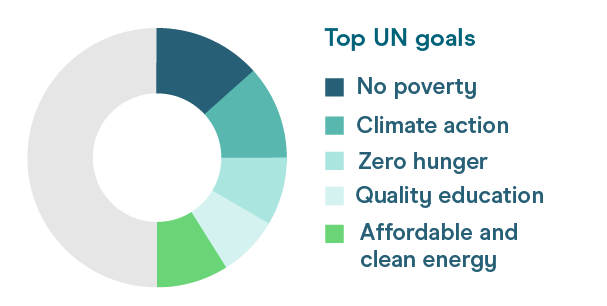
To offset our total company carbon footprint and remain a carbon neutral company, we have supported two Gold Standard projects that sit within the United Nations Sustainable Development Goals (SDGs).
To decide which projects to support, we took it to a vote. Out of a possible 17, the goals the team felt were most important were:
- No poverty (SDG1)
- Zero Hunger (SDG2)
- Quality Education (SDG4)
- Affordable and Clean Energy (SDG7)
- Climate Action (SDG13)
Projects we’re supporting
To offset our carbon output, we’re supporting two projects that best target these SDGs.
Project 1: Improved Cookstoves in Nepal
SDGs supported: 3, 7, 8, and 13 (also recognised are 1, 5, and 15)
This project, based in rural, mountainous Nepal, works to distribute efficient, biomass-fired cookstoves to replace the existing three-stone traditional ones in beneficiary households. The new stoves are designed to increase heat transfer to the cooking pot while being suitable for traditional utensils and cooking habits of people in Nepal. Plus, they will be constructed by local partners – creating local employment opportunities. So far, more than 20,000 stoves have been installed through this project, and the plan is to install at least 50,000 more.
Project 2: Renewable energy project in India
SDGs supported: 7, 8, and 13
The purpose of this project is to generate electricity through renewable wind energy sources by installing a 40-MV wind farm in Gujarat.
The project will replace anthropogenic emissions of greenhouse gases (GHG’s) of around 82,220 tCO2e per year. That means displacing the equivalent of 84,096 MWh/year in electricity from the generation-mix of power plants connected to the grid.
What’s next?
It’s great to see that despite returning to business as usual and continuing to grow as a team, we’re able to keep our carbon footprint on a downward trajectory.
Following the thorough analysis of our carbon output, here’s what we’ll continue to do and what we’ll introduce to ensure we positively impact the world around us.
- Annual carbon footprint analysis – Regularly reviewing our energy consumption helps us monitor our progress and identify areas for improvement.
- Annual offsetting – Supporting offsetting projects to the value of our annual consumption means we’re contributing to positive community projects and ensures we remain a carbon neutral company.
- Signatory of the UN Climate Neutral Now Initiative – Being a signatory, and the first UK Fintech company to sign the initiative in 2020, we hope to encourage more young companies from the UK and around the world to take climate action early on and to grow their businesses in a responsible and sustainable way.
- Hybrid working – A hybrid working model casts the right balance between the two and will ensure we maintain level energy use.
- Our ESG practices – We believe it’s important to be transparent about how we operate and what effect Moneybox has on the planet and its people. You can find all our environmental, social and governance practices at the ESG at Moneybox webpage.
- Moneybox Green Team – For the first year, we’ve formed our own sustainability committee, which meets to discuss new initiatives and ways we can keep our impact on people and the environment minimal.
- Sustainability policy – At Moneybox, we’ve always employed environmental, social, and governance practices to ensure we have a positive impact on the world around us. But we’ve finally made those practices official with our new sustainability policy.
- Helping our colleagues reduce their carbon footprint – Waste knowledge and management was one of the top requests from our employee survey. So, we’re going to start sharing more knowledge and tips with the Moneybox team on how to reduce individual waste. Further, we’ve ensured all of our waste bins around the office are clearly labelled for normal waste and recycling.
- Cycle-to-work scheme – We’ve recently introduced a cycle-to-work scheme to encourage our team to travel green wherever possible.
- Environmentally Preferred Purchasing (EPP) – We have a strong EPP strategy which means purchasing products or services that have a less negative effect on people or the environment. Moneybox drives this strategy by choosing local suppliers and good quality goods. For example, our office coffee is supplied by Pact who source all coffee directly from farmers and pay 65% above the Fairtrade base price, on average.
View our 2019 Carbon Neutral report
View our 2020 Carbon Neutral report
View our 2021 Carbon Neutral report
*The project with Alectro was undertaken in the period between 7th February 2023 – 29th March 2023, based on qualitative and quantitative data gathered from the period between 1st January 2022 – 31st December 2022
**Emission profiles: Organisational Boundaries: Alectro have used the operational control approach to establish the organisational boundary of Moneybox’s carbon reporting. As defined by the Greenhouse Gas (GHG) Protocol, this includes operations where you have the full authority to introduce and implement operating policies. Under this approach, 100% of GHG emissions from all owned and leased facilities over which Moneybox has direct operational control are included. Operational boundaries: All GHG emissions associated within the organisational boundary operations are included and categorised as Scope 1 (direct), Scope 2 (required indirect), and Scope 3 (optional indirect) emissions.
For more information about the United Nations Framework Convention on Climate Change (UNFCCC) initiative, Climate Neutral Now, visit: ClimateNeutralNow.org
For more information about Earth Day 2022, and to provide your support to fight climate change please visit https://www.earthday.org/earth-day-2023/